
U.S. House of Representatives Committee on Appropriations
Subcommittee on State, Foreign Operations, and Related Programs
Fiscal Year 2012 Budget Request
Testimony of Rabbi Michael M. Cohen
Chair, Policy Committee
The Alliance for Middle East Peace
April, 2011
Chair Granger, Ranking Member Lowey, Members of the Subcommittee:
Thank you for the opportunity to testify in strong support of the successful Reconciliation Funds program of the Office of Conflict Management and Mitigation (CMM) within the United States Agency for International Development’s (USAID's) Bureau for Democracy, Conflict, and Humanitarian Assistance (DCHA). DCHA/CMM has provided direct support through competitive grants for innovative people-to-people conflict mitigation and reconciliation programs in at least 28 countries, including those in the Middle East. As the Chair of the Policy Committee of the Alliance for Middle East Peace (ALLMEP), I urge this Subcommittee to commit:
· $28 million to the worldwide reconciliation programs funded through the Economic Support Fund in the USAID FY2012 budget; of which
· $12 million are dedicated to people-to-people peacebuilding programs in the Middle East.
ALLMEP is the coalition of some eighty (80) non-governmental organizations (NGOs), all of which promote people-to people coexistence, cooperation, and reconciliation between Israelis and Palestinians, Arabs and Jews in the Middle East. These organizations turn the challenges of daily life into opportunities for cooperation and in so doing lay the groundwork for any sustainable peace. That is the very purpose of the Reconciliation Funds Program wisely created by this Subcommittee: “bringing together individuals of different ethnic, religious or political backgrounds from areas of civil conflict and war….. [by managing] grants to programs that provide opportunities for adversaries to come together to address issues, reconcile differences, and gain understanding and mutual trust by working toward common goals.” (Neil A. Levine, Director, CMM/DCHA, USAID, People-to-People Peacebuilding: A Program Guide, January 2011)
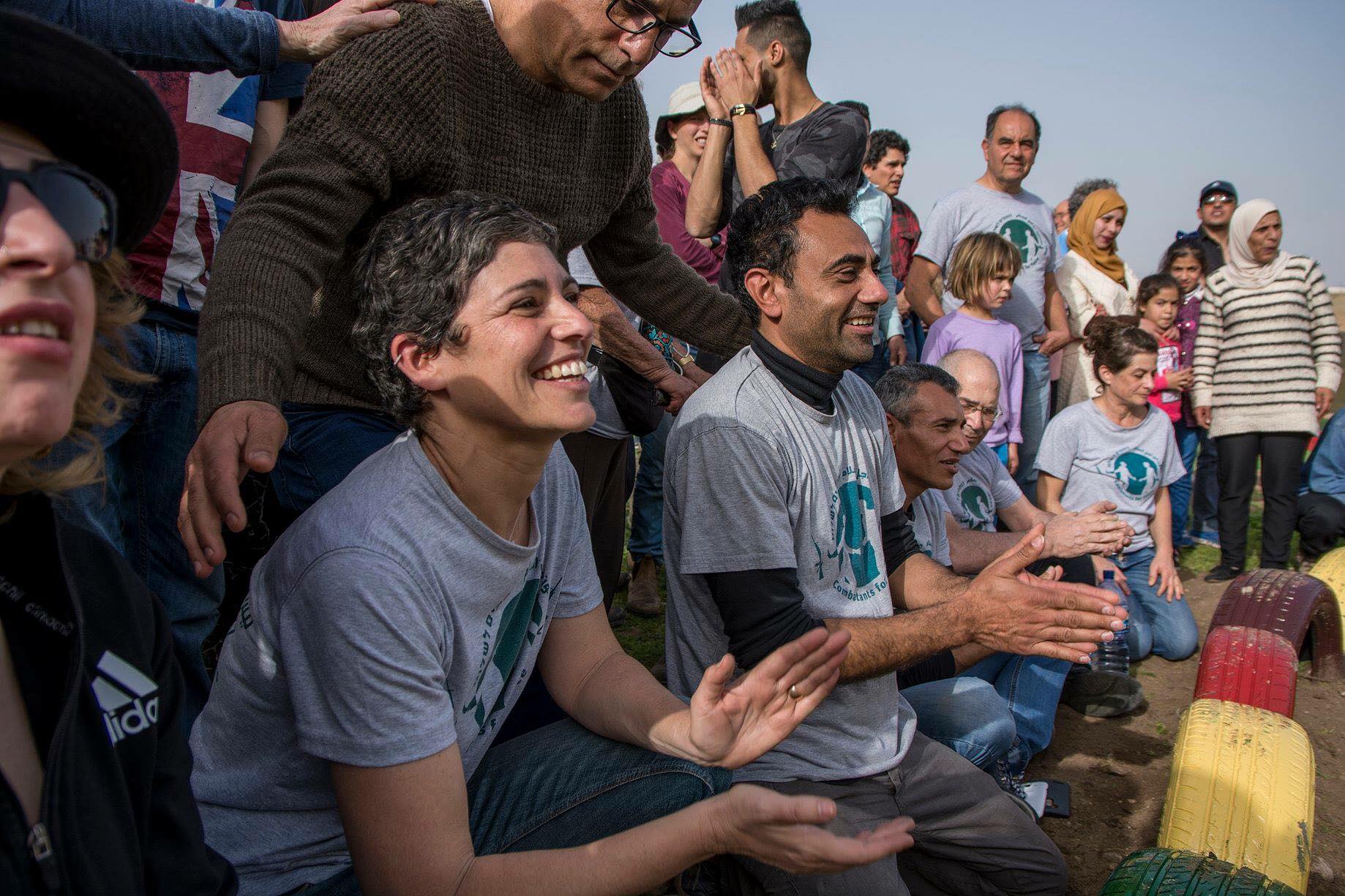
The organizations in our coalition are on the front lines of the Middle East conflict. Every day, they engage thousands of people on the ground to engage in cooperative projects, break down barriers and stereotypes, change attitudes, and lay a foundation for lasting peace. These groups help Jewish settlers and their Palestinian neighbors open constructive interfaith dialogue; they engage Israelis and Palestinians who have lost loved ones in the conflict to talk about non-violence; they create soccer and basketball leagues of tens of thousands of kids, who learn teamwork and cooperation with new friends from the “other side;” they bring together Israelis and Palestinians to cooperate in medicine, business, and education; they expose Israelis and Arabs to positive and human images of one another through TV shows and films; and they mobilize hundreds of thousands to call on their leaders to work toward a two-state solution.
Today, with the Middle East in turmoil and the peace process disappearing, the Reconciliation Funds are more important than ever. We cannot force the political leaders to negotiate, but, through the CMM program, we can empower their constituents to become a force for peace that ultimately the political leaders cannot deny. We must empower these citizen diplomats to continue their daily work -- which not only has immediate benefit but also permits embracing many more people into their movement for peace and cooperation. The NGOs in our coalition report that their scalable projects are ready to expand to new communities and participants as resources become available. In the ebb and flow of diplomacy, the ups and downs of the peace process, these marvelous NGOs funded by CMM – like the Arava Institute, Hand-in-Hand Jewish-Arab Bilingual Schools, All for Peace Radio, Parents Circle Families Forum, PeacePlayers International, and many more – are a constant. They model what politicians have failed to achieve: tangible, concrete examples of peace on the ground.
Their actions confirm that peace is no mirage, but an achievable reality. When the peace process eventually resumes – and it must—it will be these programs that have laid the groundwork and planted the seeds necessary to support a successful outcome. Said Bradley Bessire, Director, Office of Democracy and Governance, USAID/West Bank & Gaza to ALLMEP’s Executive Director: “…we have been meeting with potential CMM partners…They really are doing some of the most exciting things here!!!”
In fact: these programs work. Rigorous analyses and evaluation by USAID conclusively demonstrate greater trust; enhanced cooperation; increased “conflict resolution values”; decreased aggression and loneliness; and mitigation of hazardous environmental and health conditions between project participants from opposing sides of the conflict.
Equally important, these projects give the often-silent 2/3 majorities on both sides -- who say they support a two-state solution -- tangible ways to work toward that better tomorrow. Too often, we provide “sweetener” packages after a peace agreement is signed. That approach, however, is exactly backwards. We have not invested in “peace,” but rather “quiet,” the lesser half of “peace and quiet.” Billions in military and economic aid -- with hardly any investment in bilateral and trilateral cooperation – does not turn enemies into partners. That groundwork must be laid first, to hasten an agreement and to give it the best possible chance of success.
Bolstering nascent peace agreements through people-to-people efforts is not only critical to long-term stability, democracy and growth in the region but also to U.S. national security interests. USAID's CMM program in Israel, the West Bank and Gaza helps bolster the United States Government’s diplomatic efforts to achieve a peaceful settlement to the Israeli-Palestinian conflict by supporting programs that establish grounds for cooperation and existence and build grassroots constituencies for peace on both sides. This assistance is particularly important as supporting peace processes enhances international security. As we learned from the Marshall Plan after World War II and the recent programs supported through the International Fund for Ireland, one of the key elements to building peace between peoples that have a long history of animosity and war is building affiliations, partnerships, and relationships not just between governments, but between individuals and communities.
The peace treaties between Israel and Egypt, and Israel and Jordan were treaties between governments and not people. That has become all too clear through the rising voice of the Arab street heard in the unfolding revolutions taking place before our eyes. Just under the surface of the overt disgust of authoritarian leaders is the not-so-sub rosa dislike of the Jewish state. Yet, the many people-to-people projects underway at this very moment confirm that these people can successfully work together across borders and conflict lines, develop true professional and personal relationships, and ultimately overcome stereotypes and accept each other’s right to live in peace.
As Congress works to reduce the deficit – which we all agree must be addressed – foreign aid can become an easy target. Most Americans believe that foreign aid is 25 percent of the U.S. budget; as you know, it is actually closer to 1 percent. The U.S. gives a smaller percentage of its Gross Domestic Product than many countries, including Finland and Holland; yet it is our men and women who are in harm’s way in the regions when these conflicts persist.
Turning decades-old conflict into fertile ground for peace is a long-term effort. We will not get peace on the cheap. Without investing in peace, we cannot buy quiet forever. With the current Middle East turmoil, everything we have invested there is at risk. The billions we have spent to promote quiet on Israel’s borders with Egypt and Jordan, all the years of hard diplomacy and peace treaties, all that we have invested in security and economic development in the West Bank and Gaza, all of our own military’s commendable work to train police and bolster security cooperation – all of this is at risk unless we do more to promote actual peace. With continued investment in the CMM program, the soil will be prepared to achieve and sustain that long-sought agreement by political leaders. For this to happen, the budget of the CMM Reconciliation Funds should not be cut; if anything it should be increased.
Members of this Subcommittee: it is wiser to be proactive than reactive. I am reminded of the documentary Waiting for Superman, an indictment of the American school system. One of its most glaring revelations is that it is cheaper to send a child to private school for 12 years than to pay for him or her to spend 4 years in jail. So too, it is not only vastly cheaper to invest in peace than war, it is also an insurance policy for our own national security and the security of those in the Middle East. The American public is not waiting for Superman: we are waiting for you.
I urge you not to abandon the Israelis and Palestinians who are ready, waiting for an opportunity to become part of the solution. I urge you to take the less expensive path by continuing funding for these projects, and thereby enhancing our security, the region’s stability, and peace for our allies and friends. I implore your support for the brave and inspiring peacemakers through the “people-to-people” competitive grants programs of the USAID Office of Conflict Management and Mitigation. Please include $28 million worldwide, $12 million dedicated to the Middle East in the FY 2012 Foreign Operations Appropriations Bill.
Thank you.
Digg
Del.icio.us
Reddit
Yahoo
Newsvine
Googlize this
Facebook