

A Brief Guide to Facilitating Difficult Conversations
Across our membership and community, people are having and guiding some of the most difficult conversations of their lives. All Israelis and Palestinians have been having versions of those conversations constantly, since the onset of this war. But our community, uniquely, has been having those conversations together, Israelis and Palestinians as a single peacebuilding community. These discussions have delved deep into the horrific events which have unfolded since October 7th, as well as the shared trauma, grief, conflict, and the common commitment to a just and peaceful future for all those living in the region, rooted in our shared humanity.
As increasingly disturbing and frightening news spreads and the effects of what is happening in Israel and Palestine are felt around the world, we know that people in their own communities far from the region are also having difficult conversations. For all of those having, or wanting to have, these discussions, here are some tools for dialogue facilitation and guided conversation sourced from Harvard School of Graduate Education, Out of Eden, and Project Zero.
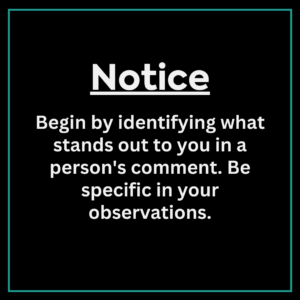
Notice: Begin by identifying what stands out to you in a person’s comment. Be specific in your observations.
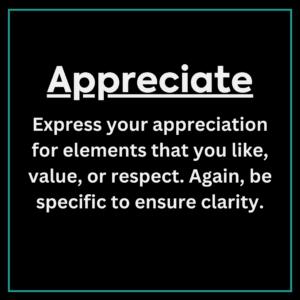
Appreciate: Express your appreciation for elements that you like, value, or respect. Again, be specific to ensure clarity.
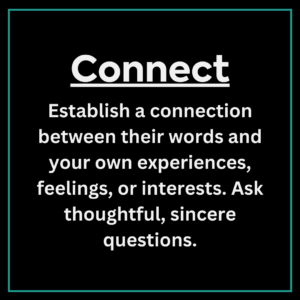
Connect: Establish a connection between their words and your own experiences, feelings, or interests. Ask thoughtful, sincere questions.
️ Point of View: Clearly express your point of view, first-person position, or opinion. Use phrases like “From my perspective…” or “In my opinion…”
Challenge: Engage in constructive discourse by questioning or challenging a point of view or idea shared by others. Try suggesting a different way of looking at an issue.
Name: Acknowledge the aspects of your identity, experiences, or context that influence your perspective. This helps others understand your own viewpoint better.
——
This resource was inspired by, The Dialogue Toolkit, a resouce guide designed by Harvard School of Graduate Education, Out of Eden, and Project Zero.
Additional Resources:
- Search for Common Ground Facilitator’s Guide: https://www.sfcg.org/wp-content/uploads/2014/02/facilitatorpdf.pdf
- Encounter Programs – Constructive Conversations Guide: A resource produced in collaboration with Public Conversations Project and Jewish Dialogue Group: https://www.encounterprograms.org/wp-content/uploads/2017/12/PCP_Israeli-Palestinian-Conflict-Guide.pdf
- USIP Global Academy – Designing Community-Based Dialogue: https://www.usip.org/academy/catalog/designing-community-based-dialogue-micro-course
- Berghof Foundation: Basics of Dialogue Faciliation: https://berghof-foundation.org/files/publications/Ropers_BasicsofDialogueFacilitation.pdf
- BC Mental Health and Substance Use Services Dialogue Facilitation Toolkit: http://www.bcmhsus.ca/Documents/08%20Facilitating%20Dialogue.pdf