


One year after 142 states endorsed the New York Declaration – the first diplomatic process that integrated civil society’s role and ideas – Palestinian and Israeli peacebuilders returned to the UN General Assembly to brief foreign ministers directly on settler violence, E1, Gaza’s recovery and forthcoming elections. Their core message: this engagement should not be ad hoc. Civil society’s role must be institutionalized within both the development and implementation of diplomacy.
NEW YORK – During UNGA High-Level Week, Israeli and Palestinian civil society leaders sat down with foreign ministers and senior diplomats from across the world to set out what is happening on the ground and what the international community can – and must – do about it.
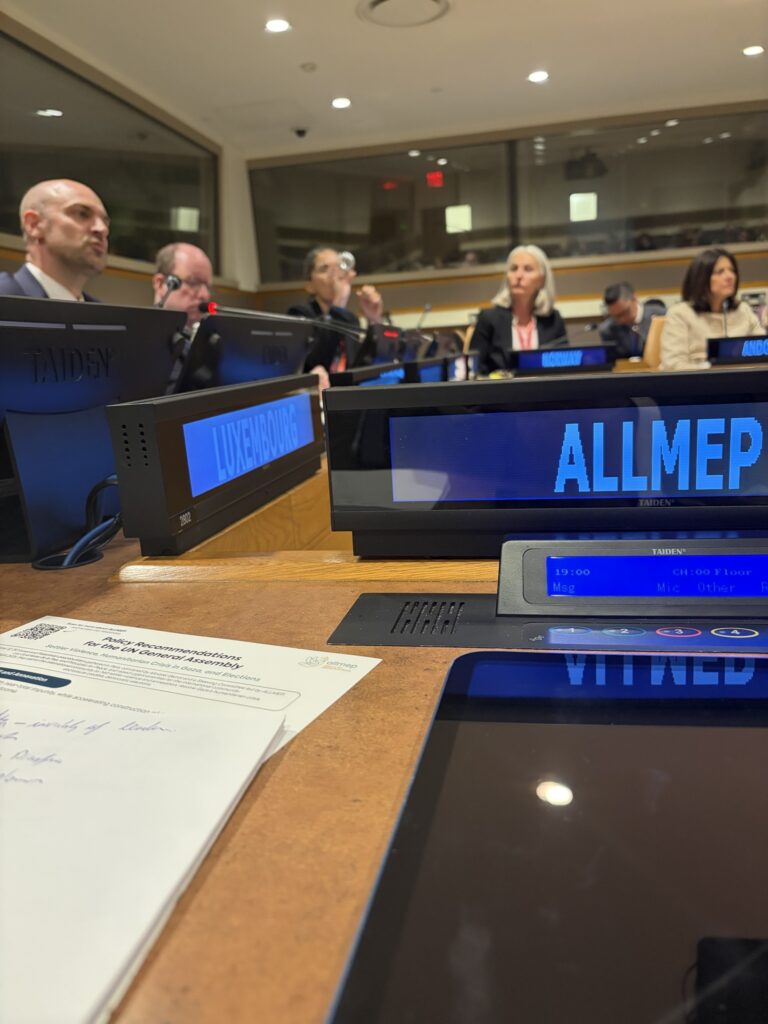
On 22 September 2026, the conference room at the United Nations headquarters was packed at a groundbreaking roundtable bringing Foreign Ministers into direct dialogue with leading Israeli and Palestinian civil society figures, convened by French Foreign Minister Jean-Noël Barrot, ALLMEP, and Les Guerrieres de la Paix.
Minister Barrot and EU HRVP Kaja Kallas opened the meeting, reflecting their governments’ leadership in institutionalizing civil society through both policy and resourcing: France through successive Paris Summits whose recommendations fed into the New York Declaration, and the EU through its largest-ever package of financial support for peacebuilders. Each spoke powerfully about the role of civil society, which HRVP Kallas described as “indispensable.”
“Without you, there would probably not have been a peace plan endorsed by resolution 2803 of the Security Council” – French Foreign Minister Jean-Noël Barrot
ALLMEP’s John Lyndon then moderated a discussion with the gathered civil society leaders, including ALLMEP members A Land for All, Terrestrial Jerusalem, and New Story Leadership, who addressed 7 Foreign Ministers and 43 high-level government representatives in attendance – not from a stage but in conversation, creating a genuine back-and-forth between the people who make policy and the people who live – and shape – its reality on the ground.
What civil society put on the table
One year after the landmark signing of the New York Declaration, grassroots leaders put concrete and urgent priorities directly before ministers, diplomats, and Middle East directors from 35 countries:
- Settler violence in the West Bank, exponentially escalating and largely unchecked.
- E1, and what construction there would foreclose.
- Gaza’s humanitarian situation and reconstruction, and who is trusted to deliver it.
- The elections ahead in both Israel and Palestine – their risks, and the openings they create.
Their insights were grounded directly in the work of ALLMEP’s Gaza Affinity Group and Protective Presence Affinity Group, through which professionals working on the ground meet to collaborate, share knowledge, and tackle mutual challenges. Across areas of operation, they showed a clear pattern: in the face of escalating violence and parallely rising needs, it is Palestinian and Israeli civil society organisations that are sustaining communities, preventing violence, generating policy options and building the constituencies any political horizon will need
As Minister Barrot concisely put it, “civil society is facing tsunamis of challenges” – but they are also coming up with practical, implementable solutions to sustain and scale their vital work.
“We cannot continue only speaking about it and having strong statements and condemning these actions, we need action on the ground to end violence for all of us.” – Rula Hardal, A Land for All Palestinian Co-Director
The building blocks for peace
The proposals put to ministers in New York did not come out of nowhere. Recommendations have been written, debated and agreed by hundreds of Palestinian and Israeli civil society members over several years.
They were shaped through dialogue with 500 Israeli and Palestinian civil society leaders culminating in the working groups of the Paris Call for the Two-State Solution in June 2025. That process fed directly into the New York Declaration, endorsed by 142 states alongside last year’s General Assembly.
They were developed further in the 2026 edition of the Paris Call, published the same week the UK, Canada and Australia launched the International Fundfor Israeli-Palestinian Peace.
And they were sharpened again this month in Brussels, where more than 80 peacebuilders and policymakers – from Northern Ireland, Rwanda, South Africa, Bosnia-Herzegovina and Cyprus among others – spent a day examining what has worked in other conflicts and what has not. ALLMEP travelled from Brussels to New York with those comparative lessons in hand.

“All of the building blocks for peace are here on the table.” – French Foreign Minister Jean-Noël Barrot
On what it will take to move from architecture to delivery, he added: “We are a resource for you as much as you are a resource to us.”
ALLMEP Regional Director Nivine Sandouka framed the challenge plainly. Civil society is already building the civic and political foundations for peace, she noted, and under conditions that would stop most organisations: “access, not capacity, is the binding constraint”.
One year on, the test of the New York Declaration is whether the governments that signed it will implement it and resource it.
The ask
The core message resonates in a clear continuum, from Paris to Brussels to New York: civil society’s role must move from ad hoc consultation to an institutionalized role in diplomacy, implementation and reconstruction. That means coordinated and sustained support for peacebuilding, greater diplomatic integration, and protection for the organisations and individuals doing this vital work.
At UNGA, civil society demonstrated exactly what it is asking for: a voice in the room, and concrete commitments on the issues that shape daily life across Israel and Palestine today, and can build a shared future for tomorrow.