
Peace Lessons, Shared: 80+ Peacebuilders and Policymakers Gather in Brussels to Learn Across Conflicts
From Northern Ireland, Rwanda and South Africa to conflicts where the struggle for peace is still ongoing, ALLMEP, Search for Common Ground, and the Parents Circle – Families Forum brought practitioners and policymakers together for “Peacebuilding Lessons from Israel, Palestine and Beyond”, to ask what has worked, what hasn’t, and what can be learned across contexts.
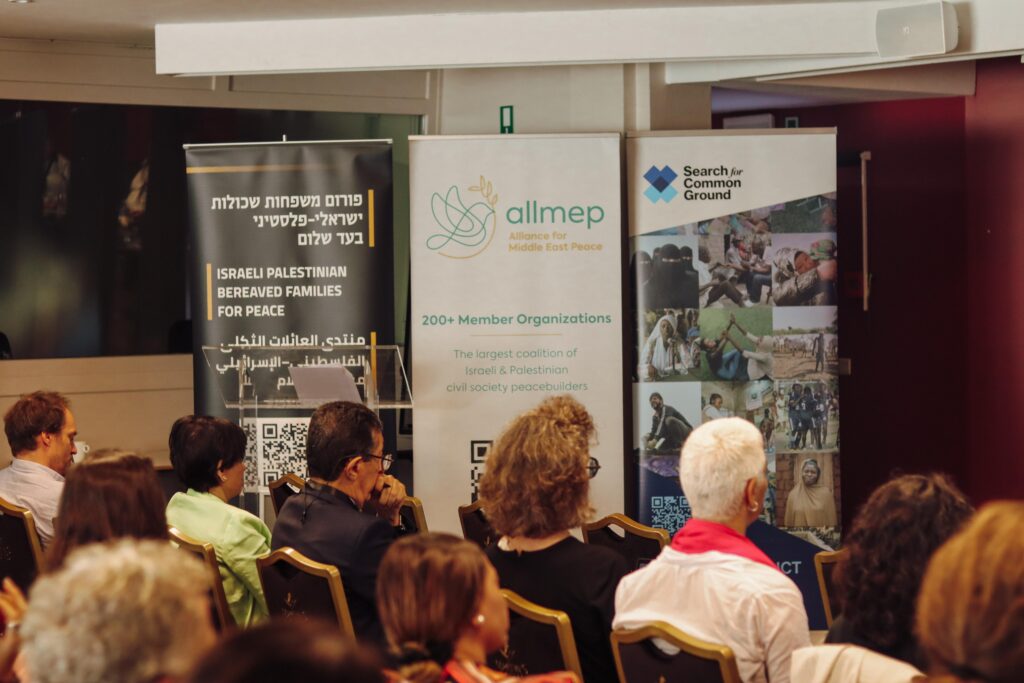
BRUSSELS – On 15 September 2026, the Alliance for Middle East Peace (ALLMEP), Search for Common Ground, and the Parents Circle – Families Forum (PCFF) convened peacebuilders, practitioners, survivors, activists and policymakers from around the world for our international conference, Peacebuilding Lessons from Israel, Palestine and Beyond.
The goal? Examine what has worked in other conflicts, what hasn’t, and what people working across very different contexts can learn from one another. The conference came ahead of UNGA High-Level Week, as conditions on the ground continue to escalate, international initiatives are met with deep skepticism, and as the conflict is again portrayed as intractable.
“We are sure that ours is the most difficult conflict in the history of mankind, but there have been others that were just as painful and bloody and they have found a way out.”
– Reflection shared by a participant during the conference*
Over 80 practitioners, civil society leaders, and decision-makers took part. 40% were Palestinian and Israeli peacebuilders. Another 40% were comparative conflict experts, including from Rwanda, Bosnia, Cyprus, South Africa, and Northern Ireland. The remaining 20% were EU, Member State and diplomatic representatives, including from the European Commission, the European External Action Service (EEAS) and national diplomatic desks.
The takeaway was not that peace is simple, or that any one model can be copied. It was that conflicts can change – and that across conflicts, it is civil society that leads the work to shift the dynamics on the ground and build the foundations for peace.

The day opened with a keynote address by Rosamaria Gili, EEAS Deputy Managing Director for Middle East and North Africa, followed by a high-level panel featuring Ambassador Johan Verkammen (Special Envoy for the Middle East, Belgian Ministry of Foreign Affairs); Avila Kilmurray (Migration and Peacebuilding Executive, The Social Change Initiative); Rami Assali (Palestine Director of Operations, Search for Common Ground); Ayelet Harel (Israeli Co-CEO, Parents Circle – Families Forum); and Wasim Almasri (ALLMEP Director of Programs).
Four thematic tracks: key insights
Discussions throughout the day were structured around four thematic tracks, here is a brief summary of them:
Track 2 mediation: limitations and new directions
Informal mediation too often reproduces the power dynamics and exclusions of formal Track 1 processes. Participants called for wider inclusion, particularly for women and youth, direct engagement with structural asymmetries, and a focus on root causes.
Track 2 is too often judged by how well it feeds negotiators upwards. Far less is invested in carrying its work downwards, to civil society and public opinion – yet in deeply traumatised societies, that is what builds readiness for peace. Participants also urged an end to seeing Track 2 as useful only when a Track 1 process exists: no conflict is solved at Track 1 alone, and there is rarely just one Track 1.
The forward way? Formalise the meeting of Tracks 1, 2 and 3 in official political processes, with better coordination between mediators and between tracks, but without jeopardising the grassroots dimension of Track 2 and Track 3 work, and the local community leaders at its heart.
Religion, identity and narrative building
Inherited post-Oslo frameworks left out questions of religion and identity, leaving the peace process “completely devoid of religion”. Ignoring these questions, participants said, has exacerbated parts of the conflict rather than mitigating them.
Participants stressed the importance of separating faith from religious identity, which is readily exploited for political ends, while people with deep religious beliefs are often deeply respectful of the beliefs of others. Although it is often instrumentalised to fuel conflict, religion can – and must – equally be reclaimed for peacebuilding instead of warmaking. Peacebuilders need to work directly with religious leaders, identity dynamics and young people to co-create narratives that make peace socially and politically imaginable again.
Balancing reconciliation, rights and justice
Rights, accountability and long-term reconciliation are not mutually exclusive, but neither are they straightforward. Reconciliation is not the same as forgiveness, and neither is the same as justice. Justice itself inevitably means different things to different people – and since there is no one type of justice, there can be no one type of process.
The process is not linear, but sequencing matters: these questions must be included from the start, stressed experts from conflicts where that was not the case, and where justice remains out of reach years on. Participants called for justice that is forward-looking, but cautioned that peace processes have to contend with mass trauma and past harms without treating reconciliation as a demand for oblivion or immediate forgiveness. Language matters, and the right message will vary across conflicts – but the peace camp must take care not to alienate different constituencies during the process.
Expanding political imagination
Settlements should start from shared values – equality, self-determination, security and dignity – rather than from predetermined final-status models. Whether one state, two states, confederation, or a new model altogether: the form must follow the principles, not the reverse.
Political imagination precedes political decisions, but transforming values into solutions requires vision, political will, and leadership. Civil society cannot and needs not wait for political will to arrive. It can and must lead this translation, showing what it looks like to live in peace and widening what counts as politically possible.
Across the tracks
Four themes echoed through every discussion.
- The inclusion and leadership of women and youth – as mediators, religious leaders beyond established hierarchies, key voices for what justice and reconciliation means, and leaders capable of imagining a new political future for tomorrow.
- Trauma – must be worked into every conversation, across every track, and addressed for all members of society.
- Root causes – must be addressed from the start of any peace process, or built into the process from the start with established mechanisms; delaying them only entrenches them.
- The role of civil society organisations – what all of the above rests on, and how it can be delivered. Civil society is already leading these key elements on the ground; their efforts and leadership must be formalised at the core of decision-making and high-level processes.
What came next, and still to come
On 16 September, the day after the conference, Palestinian and Israeli civil society leaders held a series of briefings with senior EU officials and policy desks in Brussels, bringing conference takeaways directly into policy channels.
ALLMEP then travelled to New York for the UN General Assembly, and carried the lessons and insights gathered in Brussels straight to the heart of international diplomacy.
In the coming weeks, we will publish an outcomes report with lessons learned and policy recommendations – for policymakers and peacebuilders alike.
No one model transfers from one conflict to another. But the people working to change conflicts have a great deal to learn from one another – and Brussels showed how much that exchange is worth.
*The conference was held under the Chatham House rule (except for the opening panel) to allow for open, honest conversations that went beyond the surface level to get to the core of the issues. Quotes and contributions have been anonymised accordingly unless attribution was explicitly authorised.