

Paris Peace Forum 2025: Bridging Policy and People: Civil Society at the Core of a Fused Multilateral Framework
At this year’s annual Paris Peace Forum “New Coalitions for Peace, People and the Planet”, ALLMEP and our members were present to ensure representation, voice, visibility and that urgent messages from Israeli and Palestinian peacebuilders were front and center. Alongside a continuous presence at our AI Pulse stand, we hosted a panel on integrating civil society into multilateral diplomacy, a roundtable on policy recommendations from peacebuilders, and presented our AI Pulse polling in a session on leveraging AI for social cohesion.
During the conference, ALLMEP’s Dr. Natali Levin-Schwartz presented our newest AI Pulse research concerning Israeli, Palestinian and American attitudes on key issues around peace and diplomatic pathways for resolving the Israeli–Palestinian conflict. This data is particularly interesting in this current moment where international diplomatic initiatives, such as the New York Declaration and President Trump’s 20-Point Peace Plan, which secured a ceasefire, released all living hostages, and freed Palestinian prisoners held in Israel, have come to the forefront. As Natali discussed, the polling demonstrates that the path toward diplomacy and regional normalization reflects not only international priorities but also enjoys broad public support among Israelis, Palestinians, and Americans. Read more here.

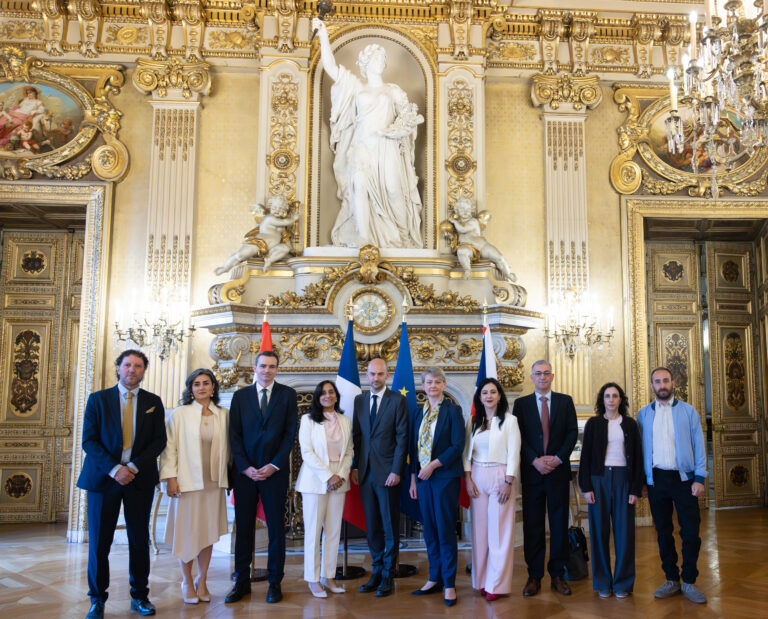
ALLMEP’s John Lyndon moderated a panel that brought Israeli and Palestinian civil society leaders together with policymakers to examine how a broader and deeper peace process, which is both multilateral and integrates civil society in shaping new diplomatic pathways toward sustainable peace, can succeed. The discussion explored how three complementary and consecutive diplomatic tracks—the civil society Paris Call, the French-Saudi New York Declaration, and the U.S. 20-Point Plan—can be aligned into a single, coherent strategy. In depth analysis was provided by Aziz Abu Sarah (InterAct), Yael Berda (ALFA) and Nivine A. Sandouka (ALLMEP) and the Director for the Middle East and North Africa from the French Foreign Ministry, Romaric Roignan, who spoke powerfully about civil society’s vital role in a re-imagined and multilateral approach to diplomacy.
“The Israeli-Palestinian conflict is probably one of the most codified diplomatic corpus… And so if we wanted to actually change the balance and reset the language, we had to go beyond classic diplomacy and really involve civil society to reach beyond governments and push them to change their classic diplomatic positions” – Romaric Roignan, Director for the Middle East and North Africa, Ministère de l’Europe et des Affaires étrangères

Watch the panel here.
Finally, a standout moment was a roundtable, moderated by Nivine, where peacebuilding leaders explored concrete ways that civil society and diplomats can work together to strengthen the fragile ceasefire and lay the groundwork for lasting peace, security, equality, and societal transformation for both peoples. The discussion drew on insights from a diverse group of voices, including Rula Hardal (ALFA), Danny Shek (Former Israeli Ambassador to France and board member at the Arava Institute for Environmental Studies), Ali Abu Awwad (Taghyeer), Rita Baroud (independent journalist from Gaza), Hakim El Karoui (l’Institut Montaigne), Hanna Assouline (Les Guerrières de la Paix), and Ofer Bronchtein (Special Envoy of President Macron for the Israeli-Palestinian peace process).
During an important discussion that cut through abstractions and analysis, each speaker emphasised the urgency of this moment and the height of the stakes. Our roundtable was joined by many senior diplomats from around the world who came to listen, ask questions, and better understand what they can do to ensure this peace agreement holds.

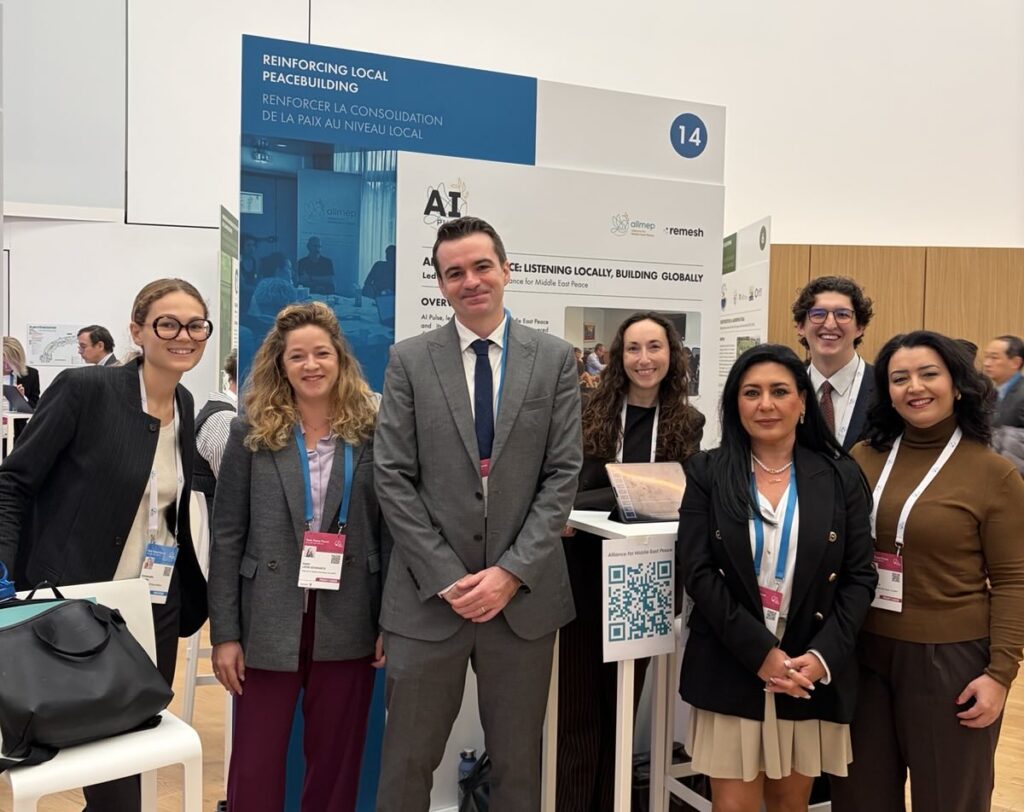
In addition, both ALLMEP and A Land for All (ALFA) were selected as part of the conference’s “Call for Solutions” under the theme “Reinforcing Local Peacebuilding”. This meant that ALLMEP and ALFA had a stand in the ‘Room for Solutions’, representing our projects to the broader public. Our stand presented our own AI Pulse, which uses deliberative AI to engage thousands of people in structured dialogues and representative polling across Israeli, Palestinian, and international publics. The goal isn’t just to collect opinions — it is to identify common ground within and across Israeli and Palestinian societies and make the public voice part of the diplomatic process, not an afterthought.
There is a contest right now to see who shapes the reality that follows the carnage of the last two years. In that context, the work, ideas and role of Israeli and Palestinian peacebuilders has perhaps never had greater importance. Which is why it is so important that they have a seat at the international decision making table.