

TEL AVIV – On Thursday April 30, the 3rd annual It’s Time summit in Tel Aviv brought together hundreds of Israeli and Palestinian civil society leaders – alongside more than a hundred diplomats – to offer an alternative path for life in the region that promises a better future for all.

The event, which featured panels, tabling, and a main event, was put together by a coalition of 80+ member organizations – many of whom are in ALLMEP’s network. ALLMEP coordinated the Diplomatic Track of the conference, and – to support the wider initiative – released new polling data from our AI Pulse initiative that tells a story that should reframe how the international community approaches this moment:
- 74% of Israelis support or would accept regional normalization and the establishment of a Palestinian state.
- 81% of Palestinians can accept a regional normalization agreement that includes a Palestinian state.
These figures have been consistent across four successive AI Pulse polls within a year. Both publics, it turns out, are ready for diplomacy. They are waiting for leadership to bring this to the table and offer an alternative to eternal conflict.
A Diplomatic Moment – and a Gap
It’s Time has a simple message this year: It can be. It must be. It will be. Peace. And the message coming from civil society comes at a moment of genuine diplomatic momentum. Frameworks like the New York Declaration, the 20-point plan, and the Global Alliance for the Implementation of the Two-State Solution are approaches to achieve a seemingly elusive diplomatic solution to the conflict.
And although civil society participation in these processes has increased, diplomacy and the publics it is meant to serve have not been connected enough. Policy frameworks that fail to reach ordinary Israelis and Palestinians risk losing the legitimacy they need to hold.
This gap – between elite diplomacy and popular understanding – is precisely the space civil society occupies. It’s Time intends to close it – and this year’s summit took another meaningful step to achieve this.
What Governments are Saying
The diplomatic commitment on display was striking. In a video address to the conference, EU High Representative Kaja Kallas spoke directly to the Israeli and Palestinian participants:
“Civil society in the Middle East has always shown that peaceful coexistence is possible, even when there is political doubt… You already know what it takes to create sustainable pathways to peace. We must catch up with you.” – HRVP Kaja Kallas, European Union
Kallas announced an additional €8 million in EU funding for civil society projects – on top of the €18 million committed last year – and reaffirmed the two-state solution as the only viable path to a region without war.
 French Foreign Minister Jean-Noël Barrot also addressed the summit in a video, building on France’s leadership following last year’s Paris Call, where over 350 Israeli and Palestinian peacebuilders shaped priorities that fed directly into the New York Declaration. He announced that France will again convene peacebuilders on June 12th in Paris ahead of the G7 Leaders’ Summit which France is chairing.
Taken together, these commitments reflect a broader shift in how the international community understands peace diplomacy:
🇮🇹 Italy led the 2024 G7 policy shift to formally integrate civil society into diplomatic processes. 🇫🇷 France convened 350 peacebuilders for the Paris Call, whose outputs fed into the New York Declaration. 🇬🇧 The UK launched a process toward an International Fund for Israeli-Palestinian Peace. 🇪🇺 The EU has now committed €26 million to civil society projects – and counting.
The Diplomatic Track: Starting Point
ALLMEP convened two high-level diplomatic panels that put policymakers and practitioners in direct conversation.
The first, titled “Starting Point,” featured a discussion with EU Special Representative Christophe Bigot, and Former Deputy Head of the Israeli National Security Council, Eran Etzion, and moderated by ALLMEP’s Nivine Sandouka, examined the Israeli-Palestinian conflict as a driver of regional instability. Discussions made clear that public support for a diplomatic pathway already exists – but is not being effectively translated into political space. Security, panelists noted, is central to both Israeli and Palestinian public attitudes, but is too often narrowly defined in diplomatic discourse.
Nivine Sandouka opened the panel, and highlighted the urgency of setting up diplomatic initiative to match the energy of the younger generation: “This conversation is especially key for younger generations, who have not lived through real diplomacy, who have never heard politicians clearly articulate the Two-State Solution, and who are looking for concrete, transformative action—not another cycle of conflict management”
Cristophe Bigot weighed in, emphasizing a bottom-up approach, saying “If you want peace, it is good to have diplomats but that is just the tip of the iceberg. The core is to change public opinions, address narratives, provide understanding, and come up with new and creative ideas.”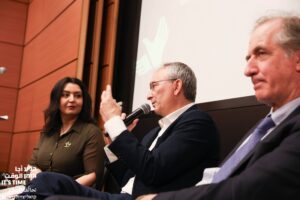
Eran Etzion weighed in, saying : “This is a moment for diplomacy, but not old-school diplomacy. We need a stronger, more urgent, and more coercive approach. (…) Civil society has been part of that shift – helping to drive initiatives like the New York Declaration, ultimately endorsed by 151 countries.”
Era of Endless War-or a New Regional Order?
The second panel, titled “Era of Endless War – or An Era of Endless War-or a New Regional Order?” featured EU Ambassador Michael Mann, Canadian Ambassador Leslie Scanlon, French Consul General Nicolas Kassianides, and moderated by Rana Fahoum of the Shalom Hartman Institute, tackled another difficult question: are we entering an era of endless war, or is a new regional order possible?
Rana Fahoum had clear insights on the topic, saying “Our main role is to prepare people for the possibility of peace. To generate language for the possibility. We speak the language of compromise with dignity, not compromise that comes from a winner and a loser”
French Consul General Nicolas Kassianides affirmed this thinking alongside the French commitment to Civil Society, saying “The link we make to civil society is not an afterthought, it is a core part of our diplomatic strategy for Israel-Palestine.”
Kassianides spoke about the upcoming G7 summit, and how the momentum of Civil Society’s work has been feeling into processes at the highest levels of government. “The content of the Paris call for TSS was the backbone of the NY declaration,” he said on the panel. “Israel and Palestinian civil society will be placed at the core of diplomatic work that France does in the context of its G7 presidency.”
“This is not a one off interaction limited to these high level events,” he concluded, underscoring the cooperative and daily nature of the work. “We work with you and support you every day on the ground. It’s an everyday link. “
EU Ambassador Michael Mann affirmed the EU’s support for civil society, echoing Kaja Kallas’ later announcement of an additional 8 million Euro of funding. “We support civil society, what you do is so important. It’s an environment that’s becoming more difficult and we are here to support you financially and politically,” he said on the panel.
These discussions culminated in a diplomatic reception, with over 130 diplomats – including 30+ Heads of Mission – and more than 100 Israeli and Palestinian civil society leaders in the same room, in direct exchange.
The Task Ahead
Following the electric energy of the It’s Time event, the thousands of attendees and strong diplomatic showing leaves behind a clear picture. Diplomatic frameworks are advancing. The data shows that publics on both sides are more ready for peace than the political conversation assumes. And increasingly, civil society is being brought into the room where decisions are made.
The task now is deepening that integration – ensuring that peace is not only negotiated at the political level, but understood, supported, and ultimately sustained by the people it is meant to serve. As the G7 approaches, ALLMEP’s 200+ members are invigorated to continue building the momentum towards a better world for all.