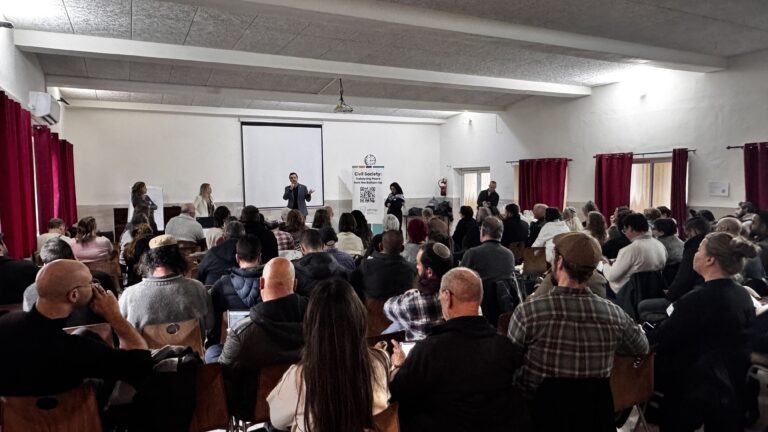


BEIT JALA – In early January 2026, ALLMEP hosted its first All Member’s Meeting of the new year. Despite a raging storm outside, over 80 Palestinian and Israeli members attended, showcasing civil society’s determination to seize the moment and make strides in the world of Israeli-Palestinian peacebuilding when it matters most.
The meeting took place at a particularly pivotal intersection for the region. While the humanitarian crisis in Gaza continues and settler violence in the West Bank rapidly increases, international developments have brought new possibilities for the peacebuilding field.
Only a few weeks prior to the meeting, UK Foreign Secretary Yvette Cooper announced that the UK will host the inaugural event of the International Fund for Israeli-Palestinian Peace in March 2026 – a move ALLMEP has long advocated for. This development, alongside US President Donald Trump’s launch of his Board of Peace, made the ALLMEP’s Member’s meeting a critical strategic convening as members collaborated to understand these developments for the region – and what role civil society can play.
ALLMEP members and staff were equally inspired to be at the gathering. “It’s an amazing experience to be here with people who think similarly about the world and our region,” said Dr. David Lehrer of ALLMEP member the Arava Institute. “All I can hope for is that next time there will be 180 [attendees, and next time 580, and that we will just keep growing.”
The meeting, led by Regional Director Nivine Sandouka, featured a comprehensive agenda of briefings from ALLMEP’s advocacy and research departments before breaking out into working groups, where members formulated policy recommendations for the upcoming London event.
 In an opening session led by ALLMEP’s Research Director Natali Levin-Schwartz, members were introduced to the latest findings from the AI Pulse research initiative. A recent study polled the global public and revealed that that 61% of respondents think their countries should invest in Israeli-Palestinian peacebuilding initiatives – identifying a global readiness for peace, and an understanding that peacebuilding is the foundation of long-term recovery. Then, Levin-Schwartz presented the results of ALLMEP’s Monitoring, Evaluation, and Learning (M&E) research, which uses survey data to assess and strengthen the impact of peacebuilding initiatives across the region. This research, grounded in months-long qualitative and quantitative research with our member network, will significantly strengthen shared learning, collaborating, and reporting throughout ALLMEP’s ever-growing network.
ALLMEP’s advocacy team presented the latest critical developments in the USA and the UK, and Europe. US Director Kari Reid updated the membership on the state of US funding, as lawmakers in chambers of Congress negotiated a foreign assistance bill that includes $37.5M in new funding for the Nita M. Lowey Middle East Partnership for Peace Act (MEPPA), negotiated in close coordination with the Administration. In addition, the Administration already has $50M in previously appropriated, unobligated MEPPA funds available to be deployed to support civil society peacebuilding efforts. This creates a timely opportunity for ALLMEP and its members to help shape and deliver the civil-society component of Phase II of the peace plan.
Executive Director John Lyndon explained the significance and process of the London Inaugural event. He explained how, fundamentally, international support for the Fund is recognition that transforming a ceasefire into a durable peace will require integrating civil society as a central component of the process. He stressed how the announcement reflects international willingness to implement the promise of the 2024 G7 Leaders’ Communiqué to “coordinate and institutionalize support for civil society peacebuilders as part of a wider diplomatic strategy.” This further builds on the New York Declaration that integrated many civil society ideas generated from the Paris Call – proposals that ALLMEP members themselves generated in June 2025 in the Paris Peace Convening. Increasingly, civil society is generating policy proposals that governments around the world are building upon – articulating that peace cannot be secured solely through political negotiation without integrating the people building change on-the-ground.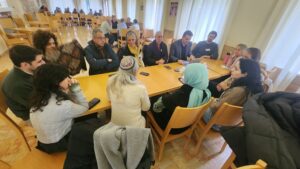
Finally, Director of Strategic Relations Brian Reeves also shared an update on the latest EF/EU call for funding, which benefited from a community-based, innovative, and rapid response on the part of the ALLMEP member networks. Many of the grantees were consortiums of different NGOs who connected through ALLMEP’s network. The call generated the highest number of applications ever on record to EU or USAID grants – highlighting the sheer productivity, creativity, and energy of civil society at this critical juncture.
Following these comprehensive updates, members broke into working groups to discuss strategic plans and proposals for the upcoming London event. Their proposals ran the gamut from material resourcing to tactical messaging, and always prioritized the lived needs and tactics that will serve their local communities.
The gathering was inspiring, to members and the ALLMEP team alike. “There’s no shortage of ideas from this peacebuilding community,” said ALLMEP Executive Director John Lyndon. “Hopefully now there’s the chance to see them reach a level we’ve never seen before, at a time they’ve never been more needed.”
As ALLMEP’s network looks ahead to the UK’s Inaugural International Fund event in March, members are moving forward with hopeful determination. Despite the shifting regional dynamics, ALLMEP members are taking the momentum of the international fund launch and the Board of Peace to continue their work. Their advocacy – locally rooted, politically adept, and responsive to the needs on-the-ground – is building the path to peace for a better life in the region for all.