
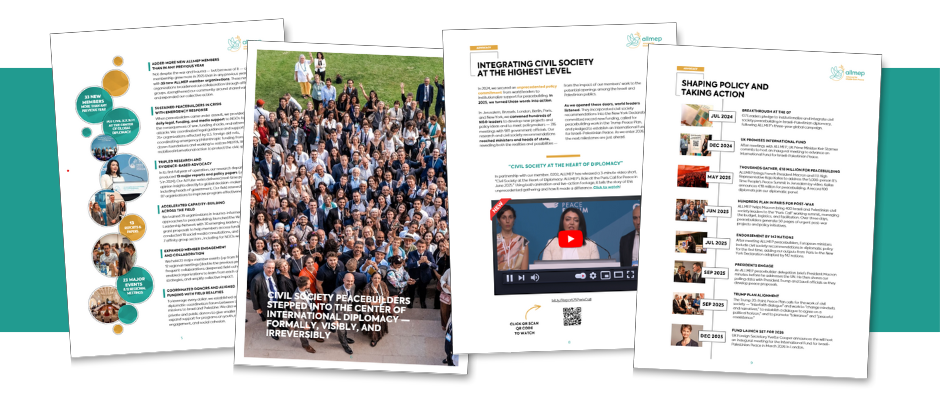
January 2026 — As violence and political instability continued to dominate the Middle East in 2025, ALLMEP’s 2025 annual report demonstrated record growth and major breakthroughs as Israeli and Palestinian civil society peacebuilders expanded their influence, secured unprecedented international recognition, and helped shape global diplomatic efforts.
Despite what ALLMEP Executive Director John Lyndon described as “extraordinarily difficult times,” ALLMEP reported record growth across its network. “Not despite the war and trauma ‒ but because of it, ” Lyndon said, more new member organizations joined ALLMEP in 2025 than in any previous year. The alliance now includes more than 180 Israeli and Palestinian organizations working across dialogue, policy, education, economic cooperation, and trauma recovery.
Lyndon spoke to this in the opening letter of the Annual Report, which covers ALLMEP’s breakthroughs in advocacy and on-the-ground impact. “Too often, the most extreme voices and ideas dominated public discourse,” Lyndon said. “But our community of peacebuilders—and supporters like you—refused to be sidelined.”
Civil Society Enters the Diplomatic Mainstream
The past year was a turning point for the role of civil society in international diplomacy, ALLMEP’s annual report shares. After years of coordinated advocacy and coalition-building, 2025 had peacebuilding organizations moved from the margins to the center of diplomatic engagement, with governments increasingly recognizing their role in shaping conditions for long-term peace.
Throughout the year, ALLMEP convened thousands of Israeli and Palestinian civil society leaders at major international gatherings, including large-scale meetings in Jerusalem, Brussels, New York, and the UK. One highlight was and a high-profile summit in Paris hosted at the invitation of French President Emmanuel Macron, where 350+ Palestinian and Israeli Peacebuilders flew to Paris to produce policy recommendations and meet Macron at the Elysses.
“These weren’t photo ops,” Lyndon emphasized. “They were breakthrough interventions influencing the public conversation and policy.”
At the Paris convening, peacebuilders developed policy recommendations and project proposals that were later incorporated into the New York Declaration, adopted by 142 countries at the United Nations. Shortly thereafter, the Trump Peace Plan explicitly highlighted civil society’s role in promoting “tolerance, coexistence, and changed narratives and mindsets.” ALLMEP is incredibly proud to have been part of centering civil society’s voice, and will continue to advocate for their inclusion at the negotiating table in the year to come. 
Record Government Commitments
Alongside increased political recognition, governments made historic financial commitments to Israeli-Palestinian peacebuilding in 2025.
The European Union announced a €18 million investment in civil society peacebuilding initiatives, one of the largest such commitments to date. In the United Kingdom, the Foreign Secretary advanced a long-standing ALLMEP initiative by committing to host the inaugural meeting of an International Fund for Israeli-Palestinian Peace in March 2026—a concept ALLMEP has pursued since 2009.
These developments and commitments build on the G7 communique of 2024, and represent further steps toward creating permanent, government-backed infrastructure to support peacebuilding efforts at scale.
Defending and Strengthening the Field
For all of ALLMEP’s growth, 2025 presented record challenges. Cuts to U.S. foreign assistance and proposed legislation threatening civic space placed many peacebuilding organizations at risk. At ALLMEP, we responded by providing daily support to members, including legal resources, media assistance, and emergency connections to philanthropic funders.
At the same time, we continued to invest in strengthening the field internally. ALLMEP’s research capacity tripled in 2025, driven by the expansion of our groundbreaking AI Pulse initiative. The program combines public opinion polling with deliberative AI dialogues to identify areas of consensus and opportunity across Israeli, Palestinian, and international publics.
Findings from these studies attracted attention from major media outlets and policymakers, including senior government officials.
ALLMEP’s affinity group programming and on-the-ground networking also increased in size and scale. Our regional team expanded training for organizations working with traumatized communities during wartime, coordinated expertise through sector-based affinity groups, and invested in leadership development through its Women’s Leadership Network. This local capacity building resulted in a larger, stronger network, one where shared work and communal engagement reached all-time highs.
Looking Ahead to 2026
As we enter 2026, “This is a fragile but pivotal moment,” Lyndon writes. “We have worked over the past two decades to ensure that global leaders recognize civil society’s centrality to any lasting peace—and we now have a real opportunity to turn that recognition into durable institutional support and meaningful progress.”
At ALLMEP, we credit our supporters for sustaining the movement through an especially challenging year. We look forward to building on 2025’s momentum as we enter 2026 and all that it will bring.


