

ALLMEP and Civil Society Voices at the Global Alliance for a Two-State Solution
On April 20th, the Global Alliance for the Implementation of the Two State Solution came together in Brussels. Over 60 countries were represented as ALLMEP’s Executive Director John Lyndon opened the meeting with a moderated panel discussion with Nida Shoughry from Itach Maaki, Gidon Bromberg from EcoPeace, and Nidal Foqaha from the Palestinian Peace Coalition.

One of the core takeaways of the session was a headline finding from ALLMEP’s new AI-Pulse data: 70% of Israelis and 80% of Palestinians support or accept the Global Alliance framework – including regional normalization and the establishment of a Palestinian state.
Yet despite this level of underlying public openness, the framework itself remains largely unknown to the very societies it is intended to serve. Few Israelis or Palestinians are aware that such an initiative exists — or that nearly 90 countries are actively engaged through the Global Alliance to advance it.
This disconnect matters. It risks limiting the political space for progress precisely at a moment when public receptivity appears to exist.
👉 Closing this awareness gap is exactly where civil society has a unique and essential role to play.
John opened the session with a powerful reminder: when civil society is integrated into peace processes, they are 64% more likely to succeed.
Civil society can speak to publics on both sides. It can de-risk and socialise new and sometimes difficult ideas, build trust, and bring voices to the table that diplomats alone can’t reach, and deliver when governments stall. As John stated “civil society has the core ability to go out and win in the competition of good and bad ideas.”
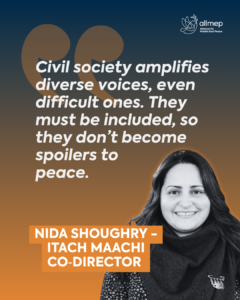
Some of these ideas may be contentious — but, as Nida put it: “Civil society amplifies diverse voices, even difficult ones. They must be included so they don’t become spoilers to peace.”
This was a point emphasized by Nidal as well: Those who matter are not currently in the decision-making process, especially women and youth, but also minorities and those who are usually silenced.
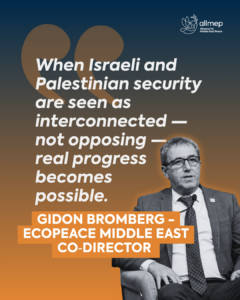
Civil society also has a track-record of impact, delivering when governments stall. As Gidon highlighted, during the war in Gaza, EcoPeace successfully led the advocacy efforts in Israel to reconnect the first cross-border water pipeline into Gaza. Within a few weeks, all three were back up. And the benefit here lies not only in the direct services provided, but the messages that come with it: “Civil society can speak to publics on both sides, to convince them of the need and security related to them all. These issues affect Israeli and Palestinians jointly. Disease and water contamination know no borders“.


This is why ALLMEP has long insisted that governments see civil society as real and permanent partners for their diplomacy. And diplomats are recognising this more and more.
These past two years have seen unprecedented levels of civil society integration into politics, and results have followed.
🇮🇹 Italy led the 2024 G7 policy shift to integrate civil society into wider Israeli-Palestinian strategy;
🇫🇷 French President Emanuel Macron convened 350 Israelis and Palestinians in Paris last year for the Paris Call, and their ideas fed directly into the New York Declaration;
🇬🇧 The United Kingdom initiated a process to launch an International Fund for Israeli-Palestinian Peace, providing the long-term finance required for peacebuilding efforts to deliver genuine change.
🇪🇺 The EU, via FPI, provided 18 million in funding to civil society projects, increasing their capacity and scale at a crucial moment.
Ahead of this year’s G7 summit, governments can build on this momentum to truly fulfil their 2024 pledge to integrate civil society as a core component of any diplomatic resolution to the Israeli-Palestinian conflict.
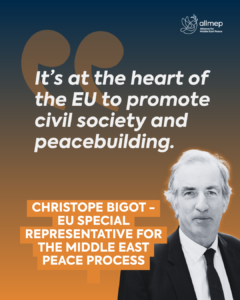
We’d like to thank the EU, FPI, EUSR Bigot, the Belgian government, and the co-hosts of the Global Alliance Norway and Saudi Arabia for including civil society leaders in this process – and making sure that high-level diplomacy is informed by the expertise from the ground.